
Table of Contents
- International Flight Power Bank Rules You Need to Know
- How to Calculate Power Bank Watt-Hours Before You Fly
- Can You Take a 20,000 mAh Power Bank on a Plane?
- Matching Capacity to Trip Length and Daily Device Needs
- Travel Power Bank Charging Tips for Long Flights and Layovers
- Size, Weight, Ports, and Charging Speed: What to Compare
- What to Do If a Power Bank Is Confiscated or Rejected
- Frequently Asked Questions
Last Updated: October 19, 2026
International Flight Power Bank Rules You Need to Know
International flight power bank rules start with one hard fact: spare lithium batteries must travel in the cabin, never in checked luggage. If you're building a travel kit around portable power banks for international travel, this guide from Mercurial walks you through the rules, the maths, and the gear choices that keep you charged and cleared for boarding.

The single rule that matters most is simple. Your power bank flies with you, in the cabin, in your hand luggage. Everything else, from watt-hour limits to airline approval, builds on that.
Carry-On Only: Why Spare Batteries Never Go in Checked Luggage
Spare lithium-ion batteries belong in carry-on baggage, full stop. The reason is safety, not bureaucracy. A battery that overheats in the cargo hold is hard to reach and hard to fight. A battery in the cabin can be seen, handled, and dealt with.
So pack your power bank in your carry-on. Keep it where you can reach it. Do not bury it at the bottom of a stuffed backpack.
Where Rules Differ Country by Country
Most countries follow similar safety logic, but the details vary. Some airlines cap watt-hours lower than the general aviation standard. Some airports screen batteries more strictly than others. A few carriers ask you to declare larger power banks at check-in.
Before you fly, check two sources: the aviation regulator for the country you're departing from, and your airline's own battery policy. The FAA guidance on lithium batteries is a useful starting point for US departures, but it does not cover every carrier or every country.
How to Calculate Power Bank Watt-Hours Before You Fly
Watt-hours (Wh) are the number airlines care about, not milliamp-hours. To convert, use this formula: Wh = (mAh ÷ 1000) × voltage. Most power banks run at 3.7V, so a 20,000 mAh pack works out to 74 Wh.
Here's the quick conversion table we use:
| Power Bank Capacity | Voltage | Watt-Hours | Typical Airline Status |
|---|---|---|---|
| 5,000 mAh | 3.7V | 18.5 Wh | Carry-on, no approval |
| 10,000 mAh | 3.7V | 37 Wh | Carry-on, no approval |
| 20,000 mAh | 3.7V | 74 Wh | Carry-on, often needs approval |
| 27,000 mAh | 3.7V | 99.9 Wh | Carry-on, approval usually required |
Check the battery label on your power bank. It should list the Wh rating directly. If it doesn't, do the maths yourself before you pack.
Can You Take a 20,000 mAh Power Bank on a Plane?
Yes, a 20,000 mAh power bank can usually go on a plane, but only in your carry-on, and many airlines require approval. At roughly 74 Wh, it sits under the common 100 Wh cabin limit, which is why most carriers allow it. Some ask you to declare it or get gate approval first.
The catch is inconsistency. One airline waves it through. Another wants it labelled and approved. A third might refuse it if the label is worn or unreadable.
So treat a 20,000 mAh power bank as "probably fine, but confirm first." Check your airline's policy page, keep the label visible, and have the Wh number ready if asked.
Matching Capacity to Trip Length and Daily Device Needs
Capacity planning is where most travellers guess, and guessing leads to either a dead phone or a bag full of unused weight. The method below estimates usable charges rather than raw capacity, because a power bank never delivers its full rated mAh to your device.
Step 1: Understand usable capacity. A power bank's rated capacity (e.g., 10,000 mAh) is measured at the internal cell voltage, typically 3.7V. Your phone charges at 5V (or higher with fast charging), and conversion loses energy as heat. A common rule of thumb is that you get roughly 60-70% of the rated capacity as usable charge at the device. So a 10,000 mAh pack delivers roughly 6,000-7,000 mAh of real charge.
Step 2: Estimate your device's battery size. Check your phone or tablet's settings or spec sheet for its battery capacity in mAh. Typical figures:
- Modern smartphone: 4,000-5,000 mAh
- Small tablet: 7,000-10,000 mAh
- Earbuds case: 500-1,000 mAh
- Smartwatch: 300-500 mAh
Step 3: Calculate usable charges per device. Divide the power bank's usable capacity by the device's battery size. For example:
- 10,000 mAh pack (≈6,500 mAh usable) ÷ 4,500 mAh phone ≈ 1.4 full charges
- 20,000 mAh pack (≈13,000 mAh usable) ÷ 4,500 mAh phone ≈ 2.9 full charges
- 20,000 mAh pack (≈13,000 mAh usable) ÷ 8,000 mAh tablet ≈ 1.6 full charges
Step 4: Multiply by trip days and devices. Add up the charges you need per day across all devices, then multiply by trip length. A 7-day trip with one phone charge per day needs roughly 7 × 4,500 mAh = 31,500 mAh of device capacity, which translates to about 45,000-52,000 mAh of rated power bank capacity after conversion losses. That exceeds the 100 Wh carry-on limit for a single pack, which is why splitting across two packs is often the practical answer.
Step 5: Match to a pack (or two).
Outdoor Household Power Bank LED Light Camping Fan →
- Weekend trip, phone only: 10,000 mAh (≈1.4 charges)
- Week-long trip, phone plus occasional tablet: 20,000 mAh (≈2.9 phone charges or 1.6 tablet charges)
- Long multi-device trip: two 10,000 mAh packs (≈2.8 combined phone charges, easier to carry and to get approved)
Two smaller packs often beat one big one. They're lighter to split between bags, each one is easier to clear at security, and if one fails you still have backup capacity.
Travel Power Bank Charging Tips for Long Flights and Layovers
Long flights and layovers drain devices fast, so plan your charging around the trip, not just the destination. Charge your power bank to full the night before you fly. Top up your phone at the gate while you still have mains power.
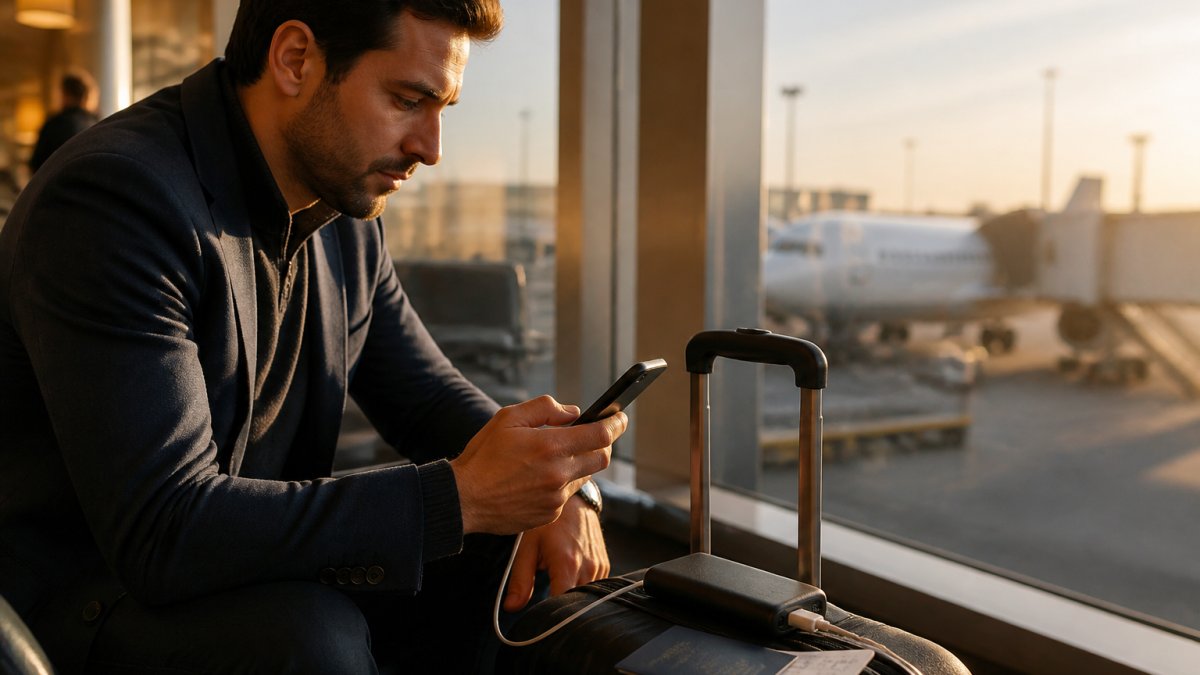
In-flight, keep the power bank in your seat pocket or personal item, not the overhead bin. Charge in short bursts rather than leaving a device plugged in for hours. It saves capacity and keeps the battery cooler.
A few habits that help:
- Use a short, good-quality USB-C cable
- Charge devices one at a time to spread output power
- Switch your phone to low-power mode during charging
- Recharge the power bank itself at every airport outlet you pass
Size, Weight, Ports, and Charging Speed: What to Compare
Size and weight matter more than raw capacity once you're carrying a bag all day. A 20,000 mAh pack is heavier and bulkier than a 10,000 mAh one, so pick the smallest pack that covers your trip.
Ports and speed decide how useful a pack really is. Look for USB-C input and output, at least two ports for multiple devices, and fast charging support for your phone. A built-in cable saves space and stops you hunting for one at the gate.
Here's what to weigh when comparing:
| Feature | What to Look For | Why It Matters |
|---|---|---|
| Capacity | 10,000-20,000 mAh | Balances trip length and weight |
| Weight | Under 400g for carry | Keeps your bag light |
| Ports | USB-C plus USB-A | Covers phones, tablets, and older gear |
| Charging speed | Fast-charge support | Less time tethered to a wall |
| Label clarity | Printed Wh rating | Speeds up security checks |
| Extras | Built-in cable, LED light | Fewer things to pack |
For travellers who want more than charging, Mercurial's Outdoor Household Power Bank LED Light Camping Fan combines a 20,000 mAh (F6) or 10,000 mAh (F8) battery with a three-speed fan and an LED light. It's a handy pick for long layovers, camping stops, and trips where one device has to do more than charge a phone.
What to Do If a Power Bank Is Confiscated or Rejected
If security rejects your power bank, stay calm and ask why. Most rejections come down to three things: the pack is in checked luggage, the label is missing or unreadable, or the capacity exceeds the airline's limit.
Ask the officer which rule applies. If it's a labelling issue, a photo of the printed rating sometimes helps. If it's a capacity issue, you may be offered options like leaving it behind or, in some cases, having it held.
Know your rights and limits. You can usually ask for a supervisor, but you cannot force a battery through security. The TSA guidance on what can fly explains the screening side in the US, and your airline's policy covers the rest.
Going forward, carry prints of your airline's battery policy and a photo of your pack's label. It won't guarantee approval, but it makes the conversation shorter.
Frequently Asked Questions
What size power bank can I take on an international flight?
Most airlines allow power banks up to 100Wh in carry-on without approval, which is roughly 27,000 mAh at 3.7V. Between 100Wh and 160Wh, many carriers require airline approval before boarding, and anything above 160Wh is generally banned. Because limits vary by carrier and country, check your specific airline's policy and confirm the Wh rating printed on the battery label before you pack. Power banks must stay in carry-on baggage, never in checked luggage.
Can I carry a 20,000 mAh power bank on an international flight?
Yes, in most cases. A 20,000 mAh power bank works out to about 74Wh at 3.7V, which sits comfortably under the common 100Wh carry-on threshold. That makes it one of the most travel-friendly capacities: enough to recharge a phone several times on a long-haul flight without triggering extra approval steps. Keep it in your carry-on, leave it in its original casing or a protective pouch, and have the label visible if security asks.
How do I calculate a power bank's watt-hours?
Multiply the mAh rating by the nominal voltage, then divide by 1,000. For example, 20,000 mAh x 3.7V / 1,000 = 74Wh. Most power banks list voltage on the label, and 3.7V is standard for lithium-ion cells. If the label only shows mAh, use 3.7V as your working figure and round up slightly so you stay on the safe side of any airline threshold. Doing this before you fly takes a minute and prevents surprises at the gate.
Do power banks have to go in carry-on luggage?
Yes. Spare lithium-ion batteries and power banks must travel in the cabin with you, not in checked baggage. Cargo holds are not pressurised or temperature-controlled the same way the cabin is, and an unattended battery in the hold is a fire risk crews cannot respond to quickly. Pack your power bank in your personal item or carry-on, keep it accessible, and never leave it loose among metal objects that could short the ports.
International travel already asks a lot of your gear. A power bank shouldn't add stress. At Mercurial, we stock travel-friendly tech accessories built for real trips, with a curated selection, competitive pricing, and convenient international shipping. Browse our electronics range and find a pack that keeps your devices charged from the gate to the gate. Get started with Mercurial and travel with one less thing to worry about.