
Last Updated: October 26, 2026
Quick Summary
To learn how to tell if jewelry is good quality, start by reading the metal stamp (925, 14K, 18K, or GP/GF for plated), then run only non-destructive home tests like the magnet, weight, and visual wear checks. Confirm craftsmanship by inspecting prongs, settings, edges, and clasps, and leave acid, scratch, and heat tests to a professional jeweler.
- A hallmark stamp names the metal and purity; no stamp is a red flag.
- A magnet tug signals ferromagnetic base metal, but no pull proves nothing.
- Home tests cannot confirm karat; they only rule out obvious fakes.
- Check that prongs sit evenly and stones do not wiggle or click.
- Online, read the material line and search reviews for tarnished or loose stone.
Table of Contents
- Start With the Metal: Purity, Plating, and Hallmarks
- How to Test Jewelry at Home Without Damaging It
- How to Tell If Gold Jewelry Is Real (and Where Home Tests Stop)
- Inspect the Craftsmanship: Prongs, Settings, and Smooth Edges
- How to Spot Quality Jewelry Online Before It Ships
- A Practical Inspection Checklist by Jewelry Type
- Pick Your Next Piece With Confidence at Mercurial
- Frequently Asked Questions
Start With the Metal: Purity, Plating, and Hallmarks
A piece of jewelry is only as good as the metal underneath the shine. Learning how to tell if jewelry is good quality starts with reading the metal, not the sparkle.
The necklace category alone was expected to hold 21.48% of the global jewelry market in 2024, according to Fortune Business Insights market data. That volume means plenty of low-grade pieces sit beside great ones on the same shelf.
What the Stamp Actually Tells You
A hallmark is a small stamp inside a ring band or on a clasp that names the metal and its purity. Common marks include 925 for sterling silver, 14K or 18K for gold, and 750 for 18-karat gold.
- 925 means 92.5% silver
- 14K means 58.5% gold
- 18K means 75% gold
No stamp is a red flag. A real piece almost always carries one.
Solid Gold, Gold Plated, or Something Else
Higher purity does not always mean a stronger piece. A widely shared point from jewelry quality guidance on Instagram notes that higher purity can mean softer metal, and that fine chains can be made from 925 silver.
Gold plating wears off over time. Solid gold lasts. Neither is "bad" if the price matches the metal. If you want to see how a silver piece labels its material, look at the S925 Sterling Silver Black Zirconia Love Twist Ring and check the marks against the listing.
How to Test Jewelry at Home Without Damaging It
Home tests are screening tools, not verdicts. They can flag a suspicious piece or give you confidence to keep looking, but they cannot confirm karat, gemstone identity, or origin. The useful approach is to run only non-destructive checks, record what you see, and escalate anything ambiguous to a jeweler.
Safe at-home checks and what each one can actually tell you
- Magnet test. A strong neodymium magnet will tug on ferromagnetic base metals such as iron, steel, and some nickel alloys. Real gold, silver, platinum, and copper are not magnetic. A positive pull is a strong fake signal; no pull proves nothing, because brass, zinc, and many plated alloys are also non-magnetic.
- Weight and feel test. Compare a piece to a known item of similar size. Solid gold and silver feel dense for their volume; hollow, plastic-core, or aluminum pieces feel light and sometimes sound hollow when tapped. This is a comparison cue, not a measurement.
- Visual and wear check. Look for flaking at edges, green or black skin marks, uneven color in recessed areas, and seams that suggest a plated base. These are common signs of plating wear or base-metal corrosion.
- Stamp and hallmark check. Use a loupe or phone macro mode to read the mark. A crisp, correctly placed stamp is a good sign; a blurry or oddly placed stamp is a caution flag, not proof either way.
- Stone security check. Gently press each stone with a soft tool or fingernail. A wiggle means the setting is loose and the piece needs a jeweler before wear.
Tests to skip or leave to a professional
- Acid testing. Jewelers use acid on a scratch plate or a filed spot. At home it can pit the surface, remove plating, and ruin resale or return value.
- Scratch and file tests. These are destructive and should only be done by a professional on a hidden area, and only with the owner's consent.
- Heat tests. Applying flame can damage stones, solder joints, and finishes, and results are unreliable without experience.
When to stop testing and see a jeweler
Book a professional check if the stamp is missing or unclear, the price is far below the metal weight, the piece is a gift or a high-value purchase, or any home test gives a mixed result. A jeweler can confirm metal content with X-ray fluorescence (XRF) or a controlled acid test, check stone identity with a refractometer or loupe, and document findings for insurance or return purposes.
How to Tell If Gold Jewelry Is Real (and Where Home Tests Stop)
The most reliable way to confirm real gold is a professional test. Gabriel & Co.'s guide to checking gold names X-ray fluorescence (XRF) and acid testing as the dependable options.
Home tests cannot confirm karat. They only rule out obvious fakes.
Watch out: a "14K" stamp can be faked on plated brass. The stamp is a claim, not a guarantee.
Inspect the Craftsmanship: Prongs, Settings, and Smooth Edges
Craftsmanship is where a piece either survives daily wear or fails in a few months. The visible cues are symmetry, finish, and how the parts connect.
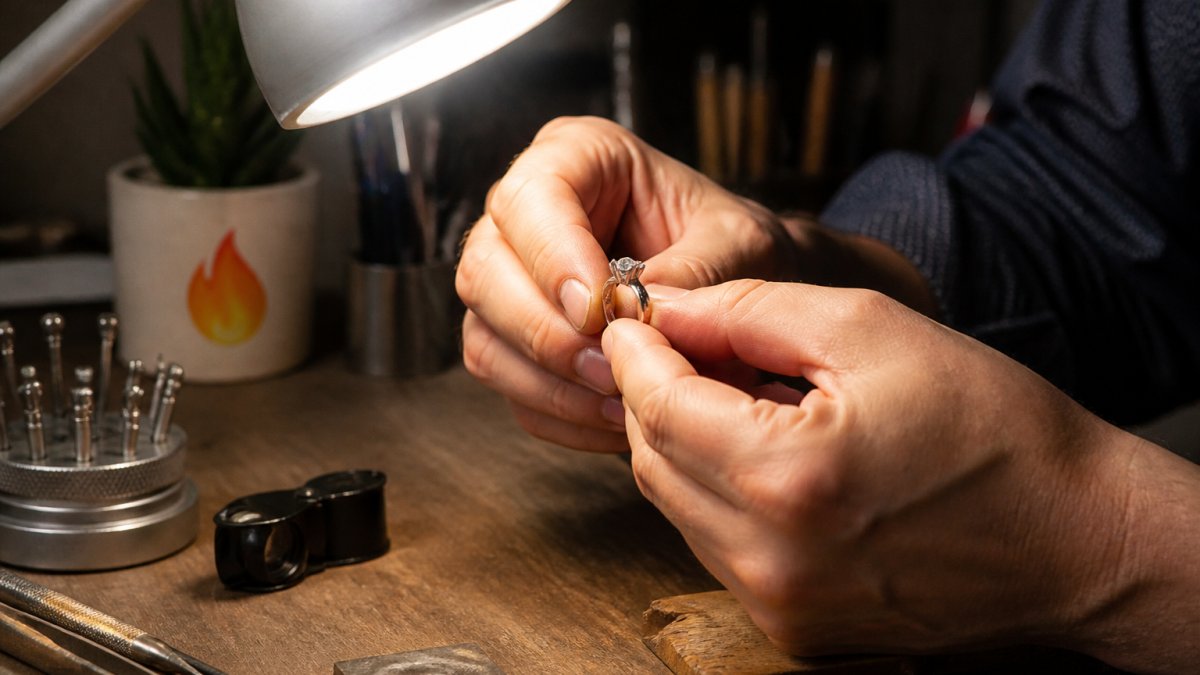
What good craftsmanship looks like up close
- Prongs. Count them and check spacing. Prongs should sit evenly over the stone, be rounded or finished at the tips, and show no gaps between metal and stone. Four or six prongs are common; fewer prongs on a large stone means more risk.
- Settings. A well-set stone sits level, with no rocking and no visible glue or filler. Bezel and flush settings hide the girdle and protect the stone; prong settings show more of the stone but need more maintenance.
- Edges and interior. Run a fingertip along the inside of a ring band and around the edges of a pendant. Rough spots, burrs, and sharp corners snag clothing and signal unfinished work.
Clasps, closures, and stone security
Open and close every closure several times. A good lobster clasp snaps firmly and returns cleanly; a spring-ring should have tension without grinding. Magnetic clasps are convenient but can release under load, so treat them as a style choice rather than a security upgrade.
S925 Sterling Silver Black Zirconia Love Twist Ring →
Press each stone gently. A loose stone moves or clicks. On a new piece, any movement is a reason to ask the seller to tighten the setting before shipping or to return it.
Durability, maintenance, and repairability by jewelry type
Different pieces fail in different places, so inspect by type:
| Jewelry Type | Stress Points to Inspect | What Good Looks Like | Maintenance and Repair Notes |
|---|---|---|---|
| Rings | Prongs, band interior, solder joint at the head | Even prongs, smooth interior, continuous joint | Prong retipping and resizing are routine; hollow or very thin bands are harder to repair |
| Necklaces | Clasp, chain links, jump rings | Firm clasp, closed links, no kinks | Thin chains stretch and kink; clasps are the first part to replace |
| Bracelets | Clasp, hinges, stone settings | Snap or box clasp engages fully, stones secure | Hinged bracelets need hinge service; stretch bracelets lose tension |
| Earrings | Posts, backs, hinges on hoops | Straight posts, tight backs, smooth hinge action | Posts can be replaced; very thin posts bend and are a common failure point |
Higher-purity metals such as 18K and 22K gold are softer and show wear faster than 14K or 18K white gold alloys, so a delicate high-karat piece may need more careful wear. Sterling silver is durable but tarnishes; rhodium plating on white gold wears over time and needs re-plating. None of these are defects, they are trade-offs to weigh against how often you will wear the piece.
Apply these checks to a specific piece, such as the S925 Sterling Silver Butterfly Ring for Women, and compare the prong spacing, interior finish, and stone security against the table above.

How to Spot Quality Jewelry Online Before It Ships
Online shopping hides flaws. Photos get brightened and descriptions get vague. Here is how to spot quality jewelry online before it ships:
- Read the material line: It should name the metal, not just say "gold tone."
- Zoom the photos: Look for even color and clean edges.
- Check the reviews: Search for words like "tarnished" or "loose stone."
- Confirm the return policy: A good seller stands behind the piece.
Compare a listing's material claims to the photos. The Tennis Chain Copper Zircon Single Row Hip Hop Bracelet lists its copper base and zircon stones plainly, which is what an honest listing looks like.

A Practical Inspection Checklist by Jewelry Type
Different pieces need different checks. Use this table as a quick guide.
| Jewelry Type | Key Check | What Good Looks Like |
|---|---|---|
| Rings | Prongs and inner band | Even prongs, smooth inside edge |
| Necklaces | Clasp and chain links | Firm clasp, no kinks |
| Bracelets | Clasp and stone security | Snap closure, stones stay put |
| Earrings | Backs and posts | Tight backs, straight posts |
Apply the checklist to a ring like the S925 Sterling Silver Black Zirconia Love Twist Ring and you will see how the checks work in practice.
Pick Your Next Piece With Confidence at Mercurial
Quality comes down to a few repeatable checks: read the stamp, test the metal, inspect the setting, and confirm the seller. Do those four things and you will spot a good piece faster than most shoppers.
At Mercurial, we curate jewelry and lifestyle pieces with clear material details and competitive pricing. Browse the I Am Enough Ring to put these checks into practice.

Frequently Asked Questions
How do I test my jewelry at home?
Start with the magnet test: real gold and silver are not magnetic, so a strong pull usually means a plated or base-metal piece. Check for a stamp such as 925 or 14K, then look for smooth edges and secure prongs. Skip the acid test unless you accept the risk of a visible mark, and remember that home tests are indicators, not proof. A jeweler's X-ray fluorescence (XRF) scan is the reliable option for confirming metal content.
How can you tell if gold jewelry is real?
Look for a karat stamp like 10K, 14K, 18K, or 24K, and check that it sits cleanly on the clasp or inner band rather than looking stamped over. Real gold feels dense for its size and does not react to a magnet. Be careful with purity as a shortcut: higher karat means softer metal, so a 24K piece dents more easily than 14K. For certainty, Gabriel & Co. recommends professional testing such as XRF or acid testing by a jeweler.
What should I look for in jewelry craftsmanship?
Check four things. First, prongs: they should be symmetrical and sit flush against the stone. Second, edges: run a finger along the inside of a ring or the back of a pendant and feel for snags. Third, clasps: a lobster claw or box clasp should click shut and stay shut under a gentle pull. Fourth, finish: a polished surface should reflect evenly with no pitting or patchy plating. On a tennis-style bracelet, look at whether the zircon stones sit level and evenly spaced.
How can I check jewelry quality when shopping online?
Zoom into the listing photos and look for close-ups of the clasp, the stamp, and the stone settings, since sellers who skip these shots usually have something to hide. Read the materials line word for word: 925 sterling silver, solid gold, gold plated, and copper are four different products. Check the return policy and whether the seller covers return shipping. Mercurial's S925 Sterling Silver Black Zirconia Love Twist Ring, for example, lists 925 silver and an adjustable opening, which tells you the metal and the fit before you order.
Ready to shop with a sharper eye? Get started with Mercurial and find standout pieces you can inspect, trust, and wear with confidence.
