
Last Updated: October 23, 2026
Quick Summary
The best magnetic bluetooth speakers for small rooms are compact models that grip ferrous metal surfaces like fridge doors, steel shelving and metal bed frames, freeing up shelf space. Prioritise mount security, controlled bass and clarity at low volume over loudness, and check battery capacity in mAh rather than marketing hours.
- Test your target surface with a small fridge magnet before buying, since mounts grip ferrous metal only.
- Run a ten-minute vibration test at 70% volume to check whether the speaker slides.
- In a small room you sit one to three metres away, so clarity at 20-40% volume matters more than peak loudness.
- The Mercurial split speaker offers S10 at 208 x 75 x 75mm and S11 at 220 x 100 x 100mm.
- Mount speakers at roughly ear height and away from corners to avoid boomy, muddied sound.
Table of Contents
- Why Magnetic Bluetooth Speakers Suit Small Rooms
- What to Check Before Buying a Bluetooth Speaker With Magnetic Mount
- Magnetic Mount Strength and Surface Testing
- Small-Room Sound: Bass, Loudness and Listening Distance
- Picking a Mini Portable Bluetooth Speaker
- Choosing a Bluetooth Speaker for Bedroom Placement
- Magnetic Speakers vs Non-Magnetic Alternatives
- Conclusion
- Frequently Asked Questions
Why Magnetic Bluetooth Speakers Suit Small Rooms
A magnetic Bluetooth speaker solves a problem regular portable speakers create: it doesn't need shelf space.
The mount is the feature, but the sound is the reason you keep it. A weak magnet plus thin audio equals a gadget you stop using after a week.
At Mercurial, we stock a magnetic split speaker that shows how the category works in practice, and we'll use it as a reference point throughout.

What to Check Before Buying a Bluetooth Speaker With Magnetic Mount
Start with the mount, not the driver. A Bluetooth speaker with magnetic mount lives or dies by how much weight the magnet holds and what surface it grips. Get those wrong and the speaker ends up on the floor.
Mount Strength and Surface Compatibility
Magnetic mounts are not universal. They grip ferrous metal, steel shelving, fridge doors, metal bed frames, filing cabinets, metal desk legs, but not aluminium, glass, wood, plastic, or low-iron stainless steel.
A common mistake is assuming a strong magnet means a safe mount. Vibration is the real enemy. Bass-heavy tracks make a speaker walk across a smooth vertical surface over time.
Sound and Battery Specs That Matter in a Small Room
In a compact room, driver size matters far less than tuning. You want controlled bass, not maximum bass, a speaker that over-emphasises low frequencies in a small, hard-walled room sounds muddy and booming within minutes.
Three specs carry real weight:
- Battery capacity in mAh, which tells you more than vague "hours" claims
- Bluetooth version, since newer versions pair faster and hold a steadier connection
- TWS or speaker linking, which lets two units form a stereo pair
The Mercurial Magnetic Split Bluetooth Subwoofer Speaker, for example, carries a 4000 mAh battery and TWS interconnection, which is the practical combination for a small room where you may eventually want two units.
Magnetic Mount Strength and Surface Testing
Most reviews call a magnet "strong" and leave it at that, useless when you're standing in your kitchen holding a speaker and a fridge door. Here's a repeatable test protocol and a surface-by-surface breakdown.
A Repeatable Mount Test You Can Run in Two Minutes
You don't need a force gauge, just a small fridge magnet, a bass-heavy track, and ten minutes. Run this sequence in order:
- The fridge magnet test. Hold a small fridge magnet against your intended surface. If it clings firmly and takes deliberate effort to slide, the surface is ferrous enough for a speaker mount. If it barely holds or falls off, stop here, no speaker magnet will fix a non-ferrous surface.
- The static load test. Attach the speaker (powered off) to the surface. Press down gently with two fingers at the bottom edge, then the top edge. Any rocking or sliding means the contact area is too small or the surface is too smooth.
- The vibration test. Play a bass-heavy track at 70% volume for ten minutes. Watch the mount continuously. A speaker that creeps even a few millimetres will keep creeping over weeks of use.
- The angle test. Vertical surfaces are harder than horizontal ones because gravity pulls along the mounting plane. A fridge door is the hardest common surface; a horizontal metal shelf is the most forgiving. Test the worst-case angle you plan to use, not the easiest.
Paint and coatings change everything. Bare or thinly coated steel gives the strongest hold; thick powder coating, enamel, or multiple paint layers add a gap between magnet and steel that can cut holding strength noticeably. If you can see a coating edge or feel a raised texture, assume reduced holding force.
Surface Compatibility: What Holds and What Doesn't
Magnetic mounts grip ferrous metal only: steel, iron, and some stainless steel alloys with sufficient iron content. They do not grip aluminium, glass, wood, plastic, or most kitchen stainless steel (often 304 or 316 grade with low magnetic permeability).
A practical surface guide based on common small-room furniture:
Magnetic Split Bluetooth Subwoofer Speaker – High-Fidelity Portable Audio →
- Fridge doors: Usually hold well if the door is steel. Test first, some modern fridges use aluminium or plastic panels over a steel core, which weakens the hold.
- Metal bed frames: Often steel and ferrous. Good for bedside mounting if the frame is bare or lightly coated. Avoid thick powder-coated frames unless the magnet is strong enough to overcome the coating gap.
- Steel shelving and filing cabinets: Reliable if bare or thinly painted. These are the safest bets because they're designed to hold weight and often have flat, unpainted contact areas.
The best mounting surfaces are often the ones you'd least want to drill into: bare steel shelving, filing cabinets, and metal bed frames, flat, ferrous, and designed to bear load.
Vibration and the Slow Slide Problem
Holding force is only half the story. Vibration is the enemy reviews ignore: a speaker playing bass-heavy music vibrates against its mount, and on a smooth vertical surface that causes a slow slide toward the edge over days or weeks.
The fix is friction, not more magnet strength. A flat, unpainted metal contact area gives the best grip, and a wide mount pad spreads the load and reduces vibration transfer.
Small-Room Sound: Bass, Loudness and Listening Distance
Most speaker reviews test in large rooms at high volume, almost useless for a 12-square-metre bedroom where you sit a metre away at 30% volume. What matters at close range in a reflective room: low-volume clarity, controlled bass, and placement that works with the room.
Why Loudness Is the Wrong Metric in a Small Room
In a small room, you're typically one to three metres from the speaker, and even a modest unit produces enough sound pressure to fill the space. The problem isn't volume, it's clarity at low volume and bass control.
A small room amplifies bass through corner loading and wall reflections, so a modest, well-controlled low end sounds fuller in a bedroom than in a large living room, while a speaker tuned for maximum bass sounds bloated and muddy.
You want a speaker that sounds clear and balanced at 20-40% volume, with bass that stays controlled rather than booming.
Listening Distance and Stereo Perception
At one to three metres, stereo perception changes. Two speakers split apart on a wide surface give real separation and a wider soundstage; a single unit on a shelf gives you a point source, everything from one spot.
If stereo matters, plan for two units or a split design from the start. TWS (true wireless stereo) pairing lets two identical speakers form a stereo pair without cables, and a split design that separates into two pieces achieves the same result with one purchase.
Placement affects stereo perception too. Mount the speakers at roughly ear height when seated, and avoid corners, which double up bass reflections and smear imaging.
Low-Volume Clarity: The Real Test
The most important test for a small-room speaker is how it sounds quietly. At low volume you hear hiss, distortion, and uneven frequency response more clearly because less sound masks them, a speaker that sounds fine at 80% volume can sound thin or noisy at 20%.
Listen for three things at low volume:
- Hiss or background noise when no music is playing. A clean amplifier and good Bluetooth implementation should be silent.
- Distortion on spoken word. Podcasts and audiobooks expose midrange problems that music can hide. Voices should sound natural, not thin or harsh.
- Bass balance. At low volume, bass should still be present but not exaggerated. If the speaker sounds bass-heavy at low volume, it will sound worse when you turn it up.
Neodymium magnet horns, used in some compact split speakers, are worth knowing about here. Neodymium is lighter and stronger than ferrite, letting a compact cabinet produce clearer highs without bulk. That's the spec that matters in a small room: clarity at low volume, not peak loudness.
Placement for Reflective Rooms
Small rooms are usually reflective, hard walls, few soft furnishings, parallel surfaces that bounce sound, which is why placement matters more than the spec sheet.
- Avoid corners. Corner placement amplifies bass and muddies the sound. Mount the speaker on a flat wall or a shelf away from corners.
- Use the room's surfaces. A metal bed frame, steel shelving, or a filing cabinet puts the speaker at listening height without adding furniture.
- Keep it off the floor. Floor placement boosts bass and puts the speaker below ear level. Mount it at seated ear height for the clearest sound.
Picking a Mini Portable Bluetooth Speaker
Choose by footprint first, then features. A mini portable Bluetooth speaker that fits your surface gets used daily; a larger one that needs a dedicated shelf often doesn't.
Size, Footprint and Portability Trade-Offs
Compact speakers trade bass extension for size, and that trade is usually worth it, a smaller cabinet in a small room sounds tighter and takes up less space. The Mercurial split speaker comes in two models, S10 at 208 x 75 x 75mm and S11 at 220 x 100 x 100mm, both black with a fabric cover.
Magnetic Split Bluetooth Subwoofer Speaker – High-Fidelity Portable Audio →
Portability is separate from size. If the speaker stays mounted, weight barely matters; if it moves between rooms, a fabric-wrapped plastic shell keeps it light and durable.
| Priority | What to Check | Why It Matters in a Small Room |
|---|---|---|
| Mount security | Magnet strength, bare metal surface | Prevents falls and vibration slide |
| Footprint | Width and depth in mm | Fits shelves, hutches, desk edges |
| Bass tuning | Controlled low end, not boosted | Avoids muddy boom in tight spaces |
| Battery | Capacity in mAh | Fewer charging interruptions |
| Pairing | Bluetooth version, TWS linking | Stable connection, optional stereo |
Choosing a Bluetooth Speaker for Bedroom Placement
A Bluetooth speaker for bedroom use has different demands from one in a kitchen or home office.
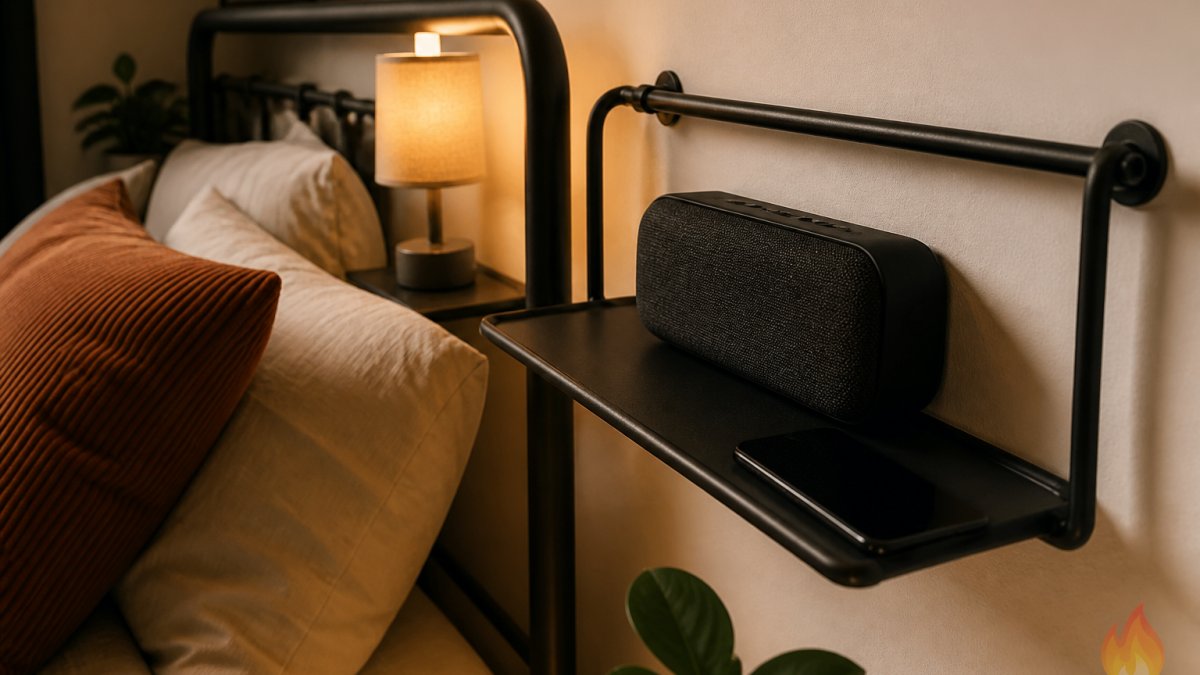
Placement drives the result more than the spec sheet. Mount the speaker at roughly ear height when sitting up in bed, and avoid corners, which double up bass reflections.
For podcasts and audiobooks, clarity matters more than bass. A neodymium horn design helps, and the HD calling feature on the Mercurial split speaker covers the occasional hands-free call.
Magnetic Speakers vs Non-Magnetic Alternatives
Magnetic speakers win on placement, not raw audio, the honest trade-off most comparisons avoid.
A non-magnetic portable speaker usually offers a bigger cabinet, deeper bass, and more driver options because it isn't constrained by a mount, but it needs a flat surface, and in a small room flat surfaces are your scarcest resource.
Magnetic models give you:
- Zero footprint on desks, shelves, and counters
- Flexible placement on fridges, bed frames, hutches, and metal shelving
- Cleaner cable routing, since the speaker sits where the surface is
Non-magnetic models give you:
- More bass extension from larger cabinets
- Broader surface compatibility, including wood and glass
- Simpler swapping between rooms
If your room has metal surfaces in useful positions, a magnetic model is the smarter buy. If it doesn't, no magnet will save you, and a standard portable speaker is the better call.
Conclusion
The hard part isn't finding a magnetic speaker, it's matching the mount to your actual surfaces and accepting that a compact cabinet trades some bass for placement freedom.
Mercurial stocks the Magnetic Split Bluetooth Subwoofer Speaker with a 4000 mAh battery, neodymium magnet horn, TWS interconnection, and a magnetic split design that separates into stereo. It's available in two sizes, so you can match the footprint to your shelf.
Frequently Asked Questions
Can a magnetic Bluetooth speaker attach to a refrigerator or metal shelf?
It depends on the mount. A magnetic Bluetooth speaker holds best on flat, ferrous steel surfaces such as a fridge door, a metal hutch, a filing cabinet or a steel shelf. Check two things before you trust it: the mount's rated hold weight and whether the surface is actually magnetic (aluminium and stainless steel often are not). Clean and dry the surface first, attach the speaker empty, and give it a gentle tug before playing anything bass-heavy. Thin panels and curved edges reduce grip.
What is the best mini portable Bluetooth speaker for a small room?
Look for a compact unit with a real bass driver rather than a single tiny full-range cone. A mini portable Bluetooth speaker around 200mm wide, like the S10 model of the Magnetic Split Bluetooth Subwoofer Speaker, fits a desk or bedside shelf without crowding it. Prioritise a 4000 mAh battery for longer playtime, TWS pairing if you want stereo later, and a magnetic mount that suits your surface. Volume claims matter less than clarity at low listening levels.
How much speaker power do you need for a small room?
Less than most people assume. In a bedroom or study, you rarely need more than a few watts to reach comfortable listening volume at one to three metres. What matters more is how the speaker handles bass without distortion and whether it stays clear at low volume. Oversized speakers often sound muddy in tight spaces and waste battery. A compact speaker with a dedicated subwoofer unit and neodymium magnet horn gives you fuller sound without filling the room with gear.
Which Bluetooth speakers have a magnetic mount, and what should I watch for?
Magnetic mount designs range from a simple magnet pad on the base to a split system where the speaker separates from its magnetic base for stereo placement. The Magnetic Split Bluetooth Subwoofer Speaker uses magnetic separation so you can position the two units apart for wider stereo sound. When comparing options, check the magnet type, the surface it is designed for, and whether the mount is built in or a separate accessory. A built-in mount is one less thing to lose.
