
Table of Contents
- What an E-Ink Phone Case Actually Does
- E-Ink Phone Case Battery Life: What the Zero-Power Claim Really Means
- E-Ink Phone Case Pros and Cons: The Honest Trade-Offs
- E-Ink Case vs LED Case: Which Rear Display Belongs on Your Phone
- E-Ink Phone Case Compatibility: Check Your Model Before You Buy
- Protection, Durability and What It Costs Over Time
- So, Are E-Ink Phone Cases Worth It in 2026?
- Frequently Asked Questions
Last Updated: October 21, 2026
What an E-Ink Phone Case Actually Does
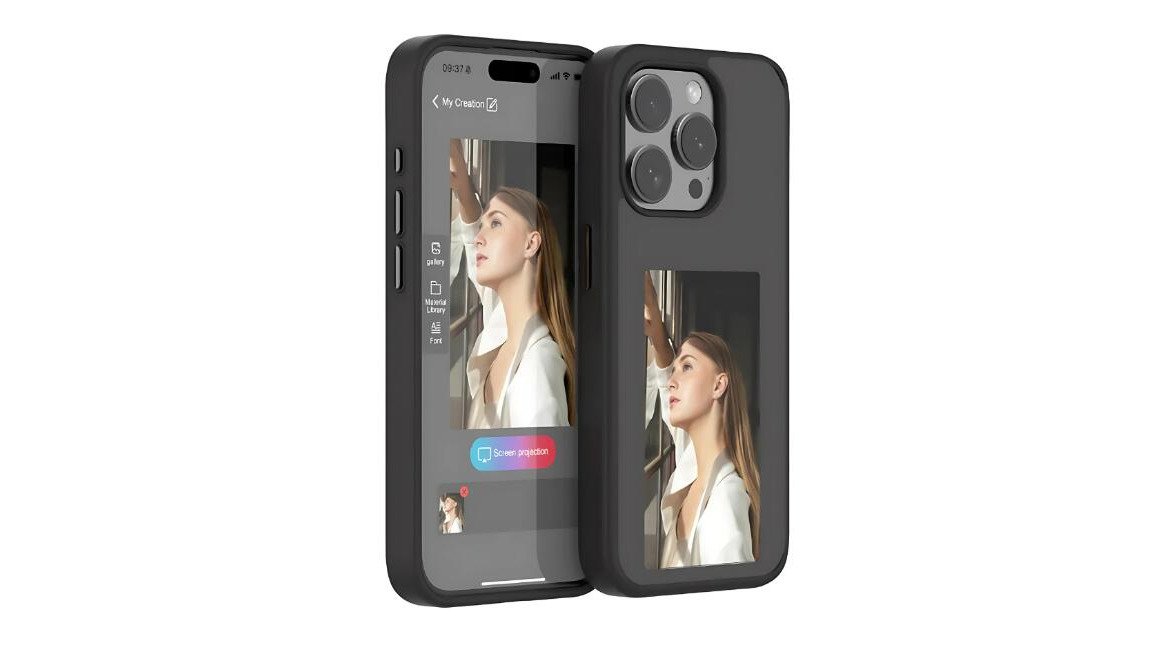
An e-ink phone case is a protective cover with a built-in electronic paper display on the back that holds a custom image, notification, or wallpaper without drawing power to keep it visible.

The appeal is simple. Your phone already does everything. The back of it does nothing. An e-ink case gives that dead space a job.
Electronic Paper, Not a Second Screen
Precision helps here, because the marketing around these cases blurs two very different things.
Electronic paper, or e-ink, moves tiny charged particles inside a display layer.
A secondary display, by contrast, is a lit screen that refreshes constantly and needs power the whole time it is on.
An e-ink phone case sits in the first category. It is a reflective display, not an emissive one.
E-Ink Phone Case Battery Life: What the Zero-Power Claim Really Means
E-ink phone case battery life is genuinely impressive, but the "zero-power" label needs unpacking.
- Holding an image: essentially no ongoing draw, because the particles stay put
- Changing the image: a short burst of power to refresh the display
- Pairing and image transfer: handled over NFC or a companion app, again brief
Set a photo and leave it for a month and you will barely notice the case exists.
What most guides miss is that the refresh rate is the real variable. Grayscale refreshes are quick and clean. Color e-ink panels refresh more slowly and can flash during the update.
E-Ink Phone Case Pros and Cons: The Honest Trade-Offs
Weighing e-ink phone case pros and cons honestly is the fastest route to a good decision. The pros are real, and so are the limits.
The pros:
- A custom image on the back that reflects your taste, not the manufacturer's
- Excellent sunlight readability, because the display reflects light rather than fighting it
- No meaningful battery drain while an image is displayed
The cons:
- Monochrome or limited color, depending on the panel
- Slow refresh compared with any normal screen
- Image updates need NFC or an app, which is a small extra step
Where E-Ink Cases Fall Short
An e-ink case is a poor fit for anyone who wants a moving, animated, or brightly lit rear display. If you want a looping video or a glow in the dark, this is the wrong product.
Refresh speed is the other sticking point. Watching an e-ink panel update feels like watching a page turn, not a screen load. Some people find it charming. Some find it slow. Both reactions are fair.
E-Ink Case vs LED Case: Which Rear Display Belongs on Your Phone
The e-ink case vs LED case decision comes down to what you want the back of your phone to do.
| Feature | E-Ink Case | LED Case |
|---|---|---|
| Display type | Reflective electronic paper | Emissive LED panel |
| Power while showing | Near zero | Continuous draw |
| Sunlight readability | Excellent | Can wash out |
| Animation | None | Yes |
| Image change speed | Slow refresh | Instant |
| Best for | Personalization, art, quotes | Notifications, effects |
If you want a case that turns heads at night, LED wins. If you want one that looks like art in daylight and never nags you for power, e-ink wins.
Our view: for everyday style and personalization, e-ink is the better buy.
E-Ink Phone Case Compatibility: Check Your Model Before You Buy
E-ink phone case compatibility is the step people skip, and it is the one that causes the most disappointment. These cases are built for specific device models, so fit is not universal. Unlike a plain case, an e-ink case has to align a display window, an NFC antenna, and cutouts all at once, which is why model matching matters more here than with a standard cover.
Before you order, confirm four things:
- Exact device model match. The case must list your exact phone model, not just the brand. "iPhone 15" and "iPhone 15 Pro" are different fits, and the display window position can differ.
- Case fit details. Check that the cutouts line up with your camera, ports, and buttons, and that the display window does not cover the camera module.
- NFC support and position. Image transfer relies on near-field communication. Your phone needs NFC enabled, and the case's antenna has to sit near your phone's NFC coil. On some models the coil is high on the back; on others it is centered. A case designed for the wrong model can make pairing unreliable even if it physically fits.
- Companion app availability. The app that sends images to the case must support your phone's operating system and, in some cases, your specific model. Check the app store listing before you buy, not after.
Why Features Differ by Phone Model
Compatibility is not just about fit; it affects features. Some models support richer image customization than others, and older devices may see fewer options, a limitation of the hardware and app, not the case.
The practical differences usually show up in three places:
- Image transfer speed and reliability. Newer NFC implementations tend to pair faster and transfer more reliably than older ones.
- App feature set. Some apps offer templates, grayscale adjustment, and scheduling on certain models but not others.
- Case availability. Popular current models get the widest case selection; older or less common models may have few or no options.
Manufacturers rarely publish a model-by-model compatibility matrix, so check the product listing's supported-model list, confirm the app works with your phone, and verify NFC is enabled before the case arrives.
Protection, Durability and What It Costs Over Time
Protection is where e-ink cases surprise people, in both directions. The display layer sits under a protective surface, and the case body absorbs everyday bumps and scratches. Our E-Ink Phone Case is lightweight and durable, with a slim profile that keeps full access to ports and buttons.
But "durable" is not the same as "rugged." To judge whether an e-ink case protects your phone as well as a conventional case, look at the same structural features you would check on any case:
- Raised edges around the display and camera. A lip that lifts the e-ink panel and camera lens off flat surfaces prevents scratches when the phone is set down. If the lip is flush, the display takes the contact.
- Corner and edge absorption. Most drop damage happens at corners. A case with reinforced corners or a TPU bumper spreads impact better than a rigid shell with thin corners.
- Grip and bulk. E-ink cases tend to be slimmer than rugged cases, which helps pocketability but can mean less material between the phone and the ground. A matte finish improves grip; a glossy one does not.
- Display-layer wear. The e-ink panel is more delicate than plain plastic. Keys and coins in the same pocket can abrade the surface over months, and pressure points (tight jeans, a crowded bag) are the usual cause of display marks rather than drops.
How It Compares with a Conventional Case
A heavy-duty rugged case wins on drop protection, full stop. Thicker walls, air pockets, and often a screen lip are things an e-ink case cannot match without becoming bulky.
For normal daily carry, an e-ink case handles scratches and minor knocks without drama. The realistic trade-off is: you give up some drop margin in exchange for a slim profile and a display on the back.
Total Cost of Ownership
Here is the angle most reviews ignore: what you actually spend over a couple of years.
| Cost Factor | E-Ink Case | LED Case | Traditional Case |
|---|---|---|---|
| Upfront price | Mid to high | Mid to high | Low |
| Charging needs | None extra | Regular charging | None |
| Replacement cycle | Long | Shorter | Varies |
| Ongoing cost | Near zero | Charging time and wear | Near zero |
| Main wear risk | Display scratches, edge wear | Battery degradation, LED failure | Yellowing, edge cracking |
A traditional case is cheapest upfront and often over time if you replace it rarely.
Value for money favors e-ink if you keep your phone two years or more and actually want the personalization: nothing degrades from constant refresh and there is nothing to recharge.
So, Are E-Ink Phone Cases Worth It in 2026?
Are e-ink phone cases worth it in 2026? For most style-conscious buyers, yes, provided you want personalization rather than a second screen.
The people who should skip it are clear: anyone who wants animation, bright notification effects, or a tap-and-read display. That is an LED case's job.
For everyone else, the trade-off is easy: you get a phone back that looks like yours, and you stop charging a case just to keep it interesting.
NFC Forum technical specifications
Frequently Asked Questions
Do e-ink phone cases use your phone's battery?
Only during an image update. The display holds its picture with no power once the refresh finishes, so a new image costs a brief draw from the case's own NFC link rather than continuous drain. In practice, changing your wallpaper once a day is negligible next to a Bluetooth connection or a screen-on session. If you rarely update the image, the case is effectively inert between changes, which is the whole point of electronic paper.
Are e-ink phone cases compatible with every smartphone?
No. E-ink phone case compatibility depends on the manufacturer offering a mould for your exact device model. Popular flagships usually get support first, while older or niche phones may never see a case fit. Before ordering, confirm your model is listed and check whether the case blocks wireless charging or camera modules. If your phone is not listed, a standard case with a printed skin is the safer route.
How does an e-ink case compare with an LED phone case?
An LED case lights up with animations and notifications but draws power continuously and can look busy in daylight. An e-ink case shows a static image you can read in direct sun, with no backlight and no ongoing battery cost. LED wins on flashy motion and app-driven effects; e-ink wins on readability, subtlety and energy efficiency. Pick LED for novelty, e-ink for a calmer, always-visible custom look.
Are e-ink phone cases durable enough for everyday use?
The display layer is more delicate than a plain plastic shell, so drop protection is the main trade-off. A raised lip and rigid back help, but a hard fall onto a corner can damage the panel. Treat it as a slim protective case rather than a rugged one, pair it with a screen protector, and expect the e-ink surface to resist scratches better than it resists impact.
The challenge with any smart accessory is separating genuine innovation from a gimmick that ends up in a drawer. An e-ink case earns its place because it solves a real problem, personalization, without asking anything of your battery in return. At Mercurial, we curate tech accessories like the E-Ink Phone Case for people who want their gear to stand out, backed by competitive pricing and convenient international shopping. Browse the collection and give the back of your phone a reason to be seen.